
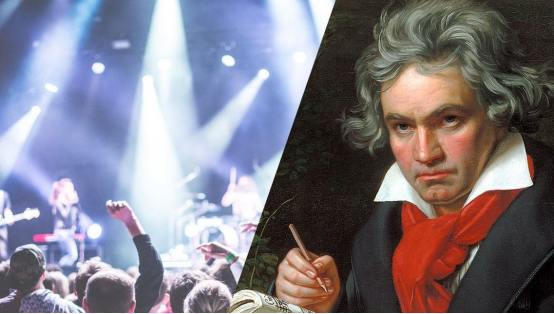
Music, as an art form, carries the cultural, emotional, and technological changes of an era. Although its core is always centered around melody and rhythm, classical music and modern music present completely different faces. Understanding the differences between these two genres not only allows us to better appreciate music, but also helps us understand how music has evolved with the changes of the times.

Classical Music: A Mirror of History
Classical music, as one of the traditions of Western music, has a long history spanning many centuries. From medieval religious music to the Renaissance, Baroque, Classical, Romantic and modernism in the early 20th century, each period has its representative composers: Bach’s exquisite counterpoint, Mozart’s melodic elegance, Beethoven’s emotional surge, and even Stravinsky’s modern sense. Each work is not just music, they are the epitome of the society, politics, philosophy and culture of that era.
The charm of classical music lies precisely in its rigorous structure and profound emotions. The complex melodies and harmonies, as well as the delicate emotional expressions, make this kind of music an eternal classic. It requires the performer to have precise skills and deep understanding, as if every note is telling a silent story. Whether you can feel the emotional tension in it often depends on whether you are willing to listen wholeheartedly.
Modern Music: Pioneer of the Times
Modern music, especially pop music, rock, hip-hop, EDM, etc. since the 20th century, gives people a brand new feeling. It is freer, more open, and explores various possibilities. Compared with the strictness and complexity of classical music, modern music seems to give people a more direct and quicker feeling of touching the heart. Popular rhythms, shocking electronic sound effects and personalized lyrics make music closer to modern life, emotional expression and social issues.
For example, the rebellious spirit of rock music, the social criticism of hip-hop, and the experimental nature of electronic music can all directly reflect the emotional pulse and technological innovation of the current era. These works are not bound by form, and often pursue richer sound effects, rhythms, and auditory experiences. The diversity of modern music gives creators unlimited freedom, and this freedom also brings about highly innovative musical works.

Structure and form: the contrast between freedom and rigor
The most intuitive difference between classical music and modern music is their structure and form. Classical music has a clear structure: from sonata form to symphony to concerto, each form has a strict rule, and the ups and downs between movements and the advancement of melody are carefully designed. Modern music is more flexible, and many works do not follow traditional music form rules. They may incorporate different styles into a song, or break the routine in the performance, making each concert a new experience.
The structure of classical music focuses more on internal logic, especially its meticulous crafting of harmony and melody. Modern music focuses on the intuitive expression of emotions, and the simplicity of melody and the impact of rhythm are often more prominent than the complexity of harmony. The variability of modern music makes the listener’s experience more diverse, while the rigor of classical music shows its eternal value in the polishing of details.
Melody and harmony: the choice between enrichment and simplification
Classical music melodies are often rich in layers and changes, with precise harmonic structures and frequent counterpoint techniques. Modern music melodies, while equally diverse, focus more on direct emotional expression and rhythm, and sometimes even use simple harmony and repeated melodies to strengthen certain emotions. You will find that in many modern music, rhythm and timbre have become more important elements than melody.
In addition, the way modern music is produced also affects the presentation of its melody and harmony. The addition of electronic sound effects and synthesizers makes the sound quality of modern music richer and more three-dimensional. Even if it is the same melody, it can bring a completely different auditory experience with the help of electronic processing.

Technological advancement: from tradition to modernity
With the advancement of technology, the way music is created and spread has also undergone tremendous changes. Classical music performances rely on live performances, and each live performance is full of unforeseen charm and challenges. Modern music, on the other hand, relies more on recording technology and digital tools, such as synthesizers, sound effects, and digital audio workstations (DAWs), which make music production more sophisticated and controllable, while also increasing the creative space for artists.
The popularity of recording technology has changed the way music is spread. Music is no longer limited to live performances, but can be spread around the world through records, radio, the Internet, etc. In particular, the development of digital audio workstations (DAWs) has enabled individual creators to produce professional-level works at home. This “democratization” process of modern music production has greatly promoted the diversity and freedom of music creation.
Cultural significance: the interaction between music and society
There are profound cultural significances behind both classical music and modern music. Classical music is often born in a historical context and reflects the social outlook of that era. For example, the grandeur and luxury of the Baroque period is a reflection of the European court society; while the intense emotions of romanticism are closely related to the individualistic ideas of the 19th century.
In contrast, modern music is more social and immediate. It directly addresses the issues and emotions of contemporary society, especially the social criticism, political commentary, and personal emotional expression common in pop music, hip-hop, and electronic dance music. The rapid spread of modern music through the Internet has broken the boundaries of region and culture, forming a more diverse and global music scene.
Conclusion: Different but timeless
Whether it is the delicacy and depth of classical music or the freedom and innovation of modern music, they have profoundly influenced us in different ways. Classical music, with its immortal artistic charm and rigorous structure, brings us a spiritual shock that transcends time and space; modern music, with its innovative spirit and diversity that keeps up with the trend of the times, inspires the emotional resonance of countless people.
Although they have significant differences in style, form and technology, both represent different aspects and values of music art. For music lovers, it is this diversity across eras and genres that constitutes the richness and charm of the music world.